5-axis CNC machining for aerospace parts matters because it allows manufacturers to continuously mill highly complex geometries—such as turbine blades and blisks—in a single setup. By maneuvering cutting tools across five distinct axes simultaneously, this advanced manufacturing process achieves the extreme precision, ultra-tight tolerances (up to ±0.0001 inches), and superior surface finishes required for flight-critical components, significantly reducing lead times and mitigating human error.
The aerospace manufacturing sector operates under a mandate of absolute zero-margin-for-error. Whether engineering commercial airliners, military fighter jets, or exploratory space shuttles, the components that make up these vessels must withstand immense atmospheric pressures, drastic temperature fluctuations, and constant vibrational stress. To meet these compounding demands, the industry relies heavily on precision computer numerical control (CNC) machining. However, traditional 3-axis methods are rapidly becoming obsolete for critical flight components. My perspective, drawn from analyzing the evolution of aerospace manufacturing, is that 5-axis CNC technology is no longer just a high-end upgrade; it is a fundamental baseline necessity for modern aerospace engineering.
The Critical Role of CNC Machining in the Aerospace Industry
Aerospace components are fundamentally distinct from parts manufactured for the automotive or consumer electronics industries. A single catastrophic failure in an aircraft engine or landing gear assembly can result in devastating loss of life and billions of dollars in damages. Because of these incredibly high stakes, aerospace precision machining has evolved to become one of the most rigorously controlled manufacturing processes in the world.
CNC machining is inherently suited for this industry due to its repeatability, scalability, and ability to handle robust materials. The subtractive manufacturing process, where a solid block of raw material (billet) is systematically carved away by computer-guided cutting tools, ensures that the structural integrity of the base material remains intact. Unlike 3D printing (additive manufacturing), which can sometimes introduce microscopic porous vulnerabilities, high-quality CNC milling guarantees solid, continuous material strength. This strength is vital for load-bearing components like wing spars, fuselage bulkheads, and engine housings.
However, as aerospace engineers design lighter, more aerodynamic, and more fuel-efficient aircraft, the geometric complexity of these parts has skyrocketed. Traditional subtractive methods simply cannot access the intricate undercuts, deep cavities, and contoured profiles of modern aerospace designs. This evolutionary bottleneck in aircraft design has positioned 5-axis machining as the definitive solution for bridging the gap between theoretical aerospace engineering and practical, physical manufacturing.
What is 5-Axis CNC Machining?
To understand why this technology is so revolutionary, we must first ask: How does 5-axis CNC machining work? In standard 3-axis machining, the cutting tool moves across three linear axes: the X-axis (left to right), the Y-axis (front to back), and the Z-axis (up and down). While effective for flat, straightforward components, it requires multiple manual repositioning setups to machine parts with details on multiple sides.
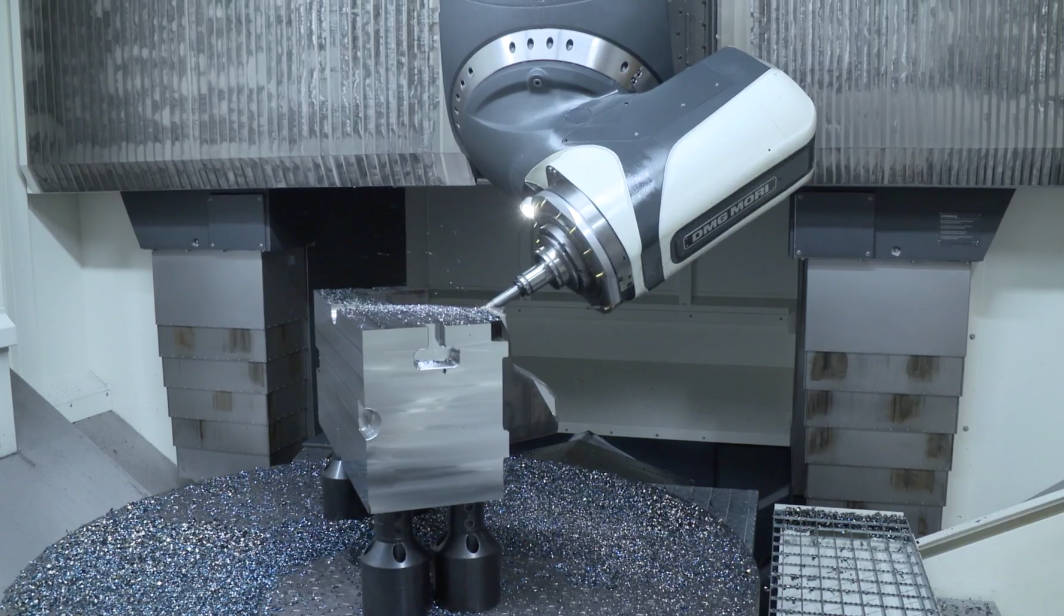
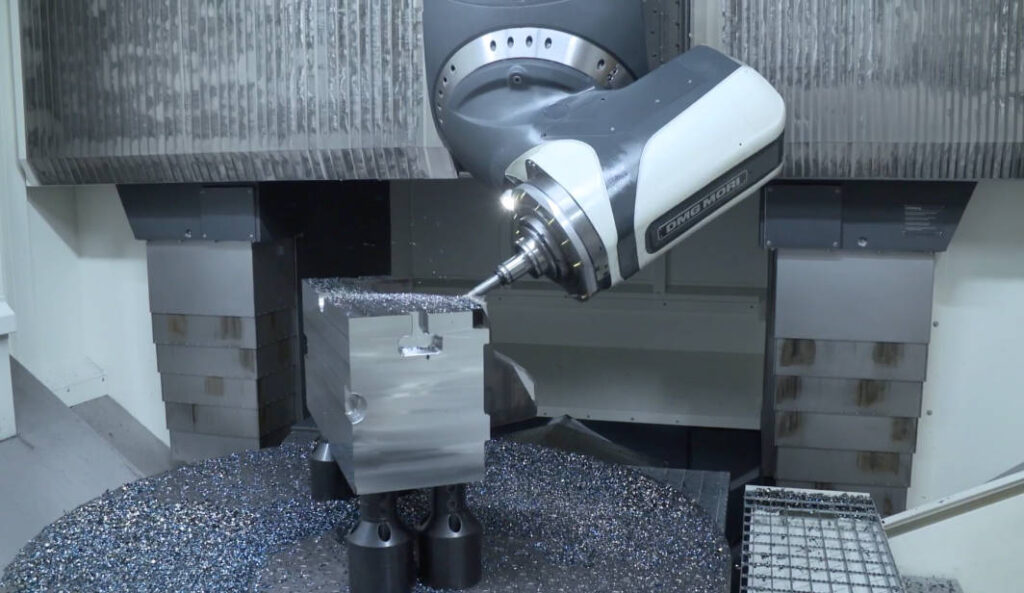
A 5-axis CNC machine adds two rotational axes—typically referred to as the A-axis (rotation around the X-axis) and the B-axis (rotation around the Y-axis), or sometimes the C-axis (rotation around the Z-axis), depending on the machine’s specific configuration. This means that the cutting tool and the workpiece can move across five distinct planes simultaneously. The tool can approach the part from virtually any direction, eliminating the physical constraints of vertical-only milling.
Simultaneous 5-Axis vs. 3+2 Axis Machining
It is crucial to distinguish between true simultaneous 5-axis machining and its positional counterpart, often called 3+2 axis machining. Both utilize the same five axes, but how they deploy them dictates their capability in aerospace applications.
In 3+2 axis machining (positional), the machine rotates the part to a specific angle using the two rotational axes, locks it into place, and then performs standard 3-axis milling. Once that section is complete, the machine stops, rotates to a new angle, locks, and resumes. This is highly efficient for multi-sided prismatic parts but falls short when dealing with continuous, sweeping curves.
In contrast, simultaneous 5-axis machining involves the continuous, dynamic movement of all five axes at the exact same time. The machine calculates the optimal tool path to keep the cutting tool perfectly perpendicular to the contoured surface of the part throughout the entire operation. This continuous fluid motion is the only way to effectively manufacture complex aerospace components like aerodynamic turbine blades, where even a microscopic step-over mark from a locked tool could disrupt airflow and cause catastrophic engine stall.
| Machining Capability | 3-Axis CNC | 3+2 Axis CNC (Positional) | Simultaneous 5-Axis CNC |
|---|---|---|---|
| Tool Movement | X, Y, Z (Linear only) | Linear 3-axis milling at locked angles | Continuous motion across 5 axes |
| Setup Requirements | Multiple setups for complex parts | Usually 1 or 2 setups | Single setup (“Done-in-one”) |
| Aerospace Application | Simple brackets, flat panels | Housings, multi-sided structural frames | Turbine blades, impellers, blisks |
| Surface Finish | Standard | Good, but may show blend marks | Exceptional, smooth contoured finishes |
Why 5-Axis Matters for Aerospace Parts
The transition from traditional milling to 5-axis technology in aerospace is driven by three foundational pillars: absolute precision, geometric flexibility, and risk mitigation through setup reduction. Let us explore each of these critical factors in depth.
Unmatched Precision and Tight Tolerances
Aerospace components are subject to some of the strictest tolerance requirements in modern engineering, frequently requiring margins of error no larger than ±0.0001 to ±0.0005 inches. At cruising altitudes of 35,000 feet, the structural expansion and contraction caused by extreme temperature drops can cause parts to warp. If a part is machined even a fraction of a millimeter out of spec, the resulting misalignment can lead to mechanical failure.
5-axis machining allows for the use of shorter, more rigid cutting tools. Because the machine head can tilt and angle itself precisely close to the workpiece, it eliminates the need for long, extended end mills. Shorter tools are inherently less prone to deflection (bending) and vibration (chatter) during the cutting process. This reduction in vibration translates directly to significantly higher precision, ensuring that the final machined aerospace part perfectly matches the initial CAD (Computer-Aided Design) model.
Navigating Complex Geometries
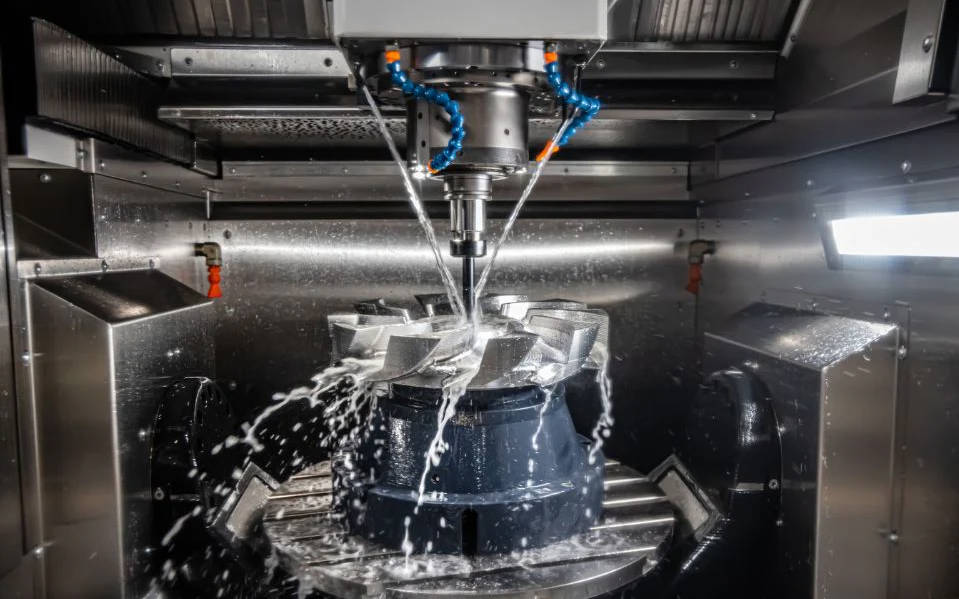
Modern aerospace engineering relies heavily on fluid dynamics and aerodynamics, resulting in parts with continuous compound curves, deep pockets, and severe undercuts. One of the most prime examples is the blisk (bladed disk), a crucial component in jet engine compressors. Historically, blades were manufactured individually and then mechanically attached to a central rotor. Today, to reduce weight and increase strength, blisks are machined out of a single, solid piece of aerospace-grade alloy.
Machining a blisk is impossible with standard 3-axis machinery. The cutting tool must maneuver between the tightly spaced, curved blades to remove material without gouging the adjacent surfaces. Simultaneous 5-axis milling is uniquely capable of this feat. The continuous adjustment of the tool’s attack angle ensures that the cutter remains constantly engaged with the material at the optimal orientation, producing complex, sweeping aerodynamic surfaces with pristine surface finishes.
Single-Setup Machining: Reducing Error and Lead Times
In traditional machining, creating a multi-sided part requires an operator to manually unclamp the workpiece, flip it, re-align it, and clamp it back down for each new side. Every time a part is handled by a human and repositioned, there is a risk of alignment error. In aerospace, “stacking tolerances”—where tiny errors in each setup compound into a massive defect—is a critical threat to quality control.
5-axis machines champion the “done-in-one” philosophy. Because the machine can access five out of six sides of a rectangular block in a single operation, the need for manual repositioning is practically eliminated. This dramatically reduces human error and ensures absolute concentricity and alignment across all features of the part. Furthermore, reducing the number of setups exponentially decreases total manufacturing lead times, allowing aerospace manufacturers to meet aggressive supply chain demands without sacrificing quality.
Conquering Aerospace-Grade Materials
Aerospace parts must be incredibly strong yet exceptionally lightweight, capable of surviving both the freezing vacuum of space and the blistering heat of engine combustion. This necessitates the use of exotic, notoriously difficult-to-machine materials. 5-axis CNC machining, combined with specialized tooling and high-pressure coolant systems, provides the rigidity and control necessary to process these superalloys.
Titanium Alloys
Titanium (particularly Ti-6Al-4V) is the darling of the aerospace industry. It offers the highest strength-to-weight ratio of any metallic element and possesses outstanding corrosion resistance. It is used extensively in landing gear, engine mounts, and airframes. However, titanium is incredibly tough and has poor thermal conductivity, meaning the heat generated during cutting does not dissipate into the chip; instead, it transfers directly into the cutting tool, leading to rapid tool wear.
5-axis machining optimizes tool paths to maintain a constant chip load and optimal cutting angles. By keeping the tool precisely engaged with the titanium workpiece, 5-axis machines prevent work hardening and minimize thermal shock, resulting in longer tool life and superior surface integrity on the finished part.
Inconel and High-Temperature Superalloys
Inconel, a nickel-chromium-based superalloy, is used in the hottest sections of jet engines and rocket thrusters. It retains its structural strength at temperatures where aluminum and steel would literally melt. Much like titanium, Inconel is intensely difficult to machine, causing severe tool wear and requiring slow, highly controlled cutting speeds.
The rigidity provided by 5-axis setups (due to shorter tools) is vital when machining Inconel. Any vibration during the cut can instantly shatter a carbide end mill. The sophisticated software driving 5-axis machines utilizes trochoidal milling strategies and continuous multi-axis morphing to slice through Inconel efficiently, preventing catastrophic tool failure while achieving the rigorous tolerances required for jet turbine exhaust components.
Adhering to Aerospace Quality Standards (AS9100)
Expertise and authoritativeness in aerospace manufacturing are heavily regulated by international standards, the most prominent being AS9100. This certification builds upon ISO 9001 but introduces stringent, aerospace-specific requirements focusing on risk management, product safety, and absolute traceability of materials and processes.
5-axis CNC machining integrates seamlessly with AS9100 requirements. Because parts are machined in a single setup, the digital thread from CAD to CAM (Computer-Aided Manufacturing) to finished part is unbroken. Modern 5-axis machines are equipped with advanced probing systems. These integrated lasers and touch-probes perform in-process inspections, verifying dimensions and tolerances while the part is still clamped in the machine. This closed-loop quality control guarantees that every aerospace part produced is completely documented, traceable, and undeniably compliant with AS9100 strictures.
Future Trends in Aerospace CNC Manufacturing
The aerospace industry is on the cusp of a new industrial revolution, and 5-axis CNC machining is adapting rapidly. One major trend is the integration of AI-driven predictive maintenance and digital twin technology. By creating a virtual replica of the 5-axis machine, aerospace manufacturers can simulate millions of tool paths to optimize cutting strategies before a single piece of titanium is ever touched. This prevents costly collisions and optimizes cutting times.
Additionally, we are seeing the rise of hybrid manufacturing machines—systems that combine the additive capabilities of 3D metal printing with the subtractive precision of 5-axis CNC milling in a single workspace. A manufacturer can 3D print a complex internal channel (like a cooling vent in a turbine blade) and then immediately use the 5-axis spindle to mill the external aerodynamic surfaces to an ultra-precise finish. This synergy is unlocking unprecedented geometric possibilities for next-generation spacecraft and supersonic aircraft.
Conclusion
The question of why 5-axis matters for aerospace parts is answered by looking at the skies. The aircraft and spacecraft of today are marvels of complex engineering, born from a necessity to push the boundaries of physics, fuel efficiency, and speed. Traditional manufacturing methods are simply incapable of realizing these modern designs safely and efficiently.
Simultaneous 5-axis CNC machining provides the ultimate combination of dynamic geometric flexibility, single-setup efficiency, and microscopic precision. By enabling the seamless processing of ultra-tough materials like Inconel and Titanium without sacrificing tolerance, 5-axis technology ensures that every blisk, bracket, and bulkhead performs flawlessly under extreme atmospheric duress. For any manufacturer aiming to compete in the aerospace sector, investing in, and mastering, 5-axis CNC machining is not an option—it is an absolute imperative.