In the advanced manufacturing landscape of 2026, the demand for high-performance components has reached an all-time high. Whether you are developing propulsion systems for aerospace, life-saving medical devices, or high-efficiency electric vehicle (EV) drivetrains, the complexity of your designs often pushes the limits of traditional manufacturing.
As a purchaser of precision machining services, you are frequently faced with a critical choice: Should you use 5-axis CNC machining or Electrical Discharge Machining (EDM)?
At HKAA Industrial, we believe that providing world-class CNC machining services starts with transparency. We don’t just want to be your vendor; we want to be your technical partner. Understanding the physics, the costs, and the geometric possibilities of these two methods will allow you to make smarter engineering decisions that save time and budget.
I. The 2026 Precision Dilemma: Choosing the Right Physics
In 2026, we are no longer limited by the “standard” geometries of the past. Generative design and AI-optimized parts often feature organic shapes, deep narrow cavities, and hyper-hard materials like hardened tool steels or superalloys.
The fundamental difference between 5-axis CNC machining and EDM is the method of material removal: 5-axis CNC uses a mechanical cutting tool to physically “chip” away material across five axes of motion, while EDM uses electrical sparks to erode material without any physical contact between the tool and the workpiece.
Choosing between them isn’t about which is “better” in a general sense—it’s about which is better for your specific material hardness, part geometry, and required tolerance.
II. 5-Axis CNC Machining: The Speed and Versatility Powerhouse
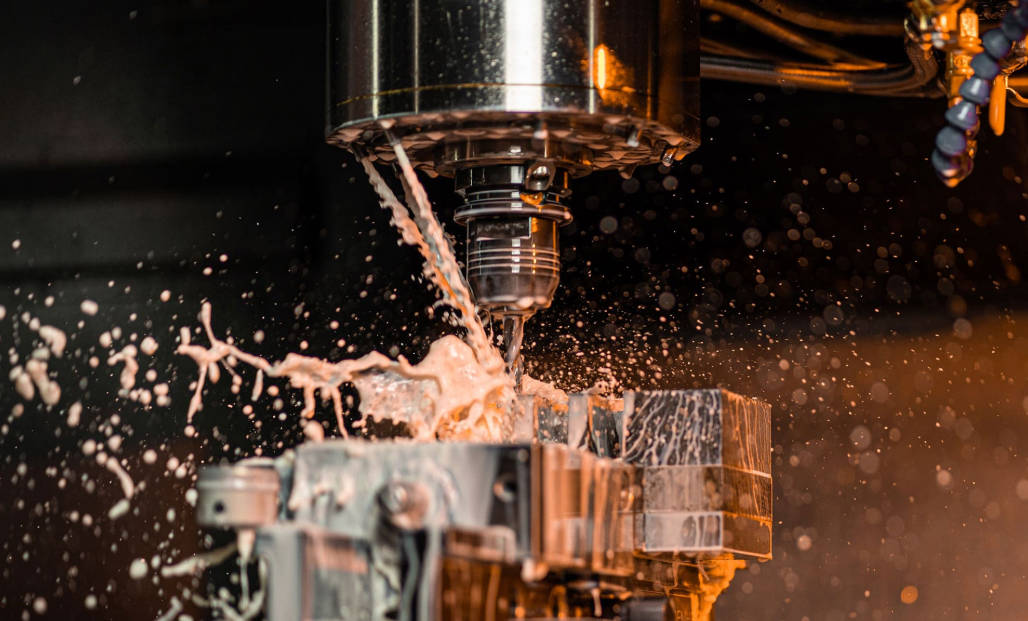
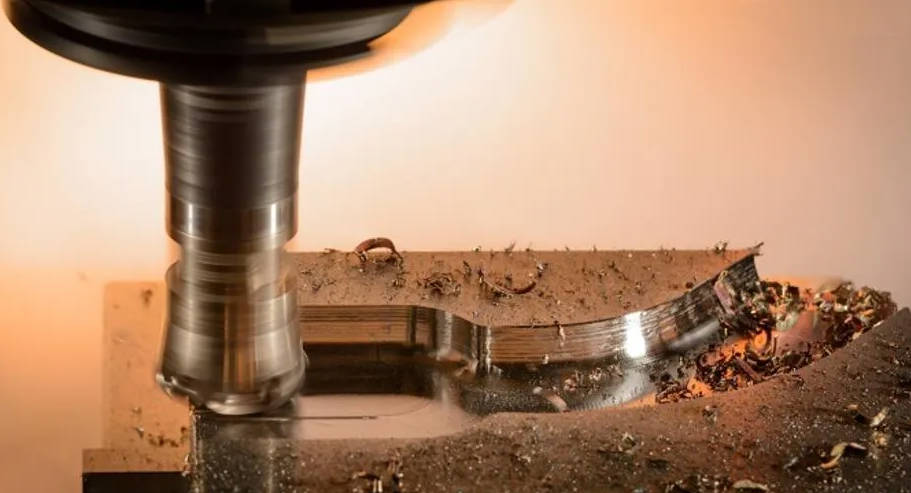
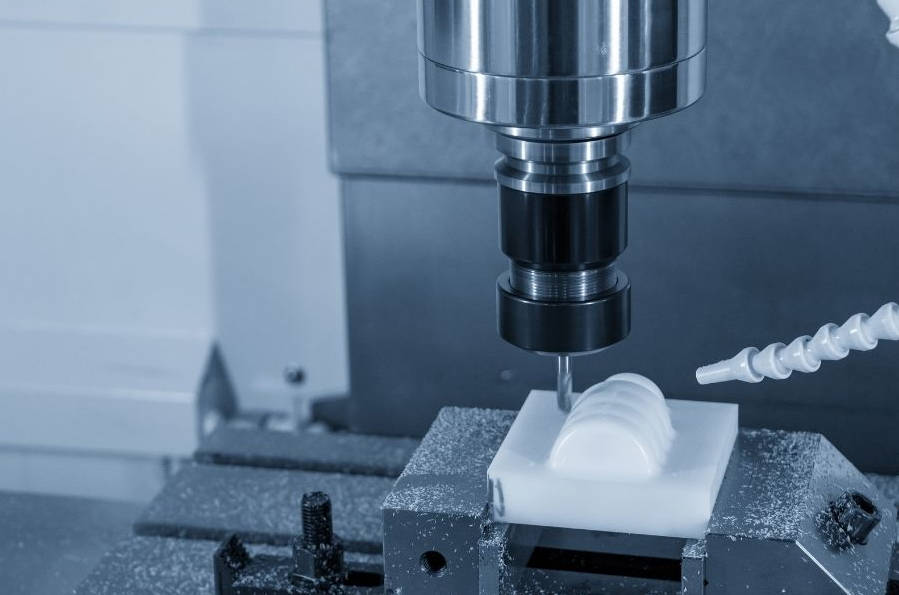
For most applications requiring CNC machining services, 5-axis milling is the first choice. By moving the cutting tool and the part simultaneously along the X, Y, Z, A, and B axes, we can reach almost any angle of a component in a single setup.
The “Sweet Spot” for 5-Axis CNC
- Organic Shapes: Ideal for turbine impellers, fan blades, and ergonomic medical housings.
- High Material Removal Rate (MRR): If you need to turn a large block of aluminum into a complex housing quickly, 5-axis CNC is significantly faster than EDM.
- Non-Ferrous Materials: It is the gold standard for Aluminum, Copper, Brass, and most Titanium alloys.
The 2026 Limitation
While 5-axis CNC is incredibly versatile, it is limited by the physics of the cutting tool. The main limitation of 5-axis CNC machining is that it cannot create sharp internal 90-degree corners because the cutting tool is always round; furthermore, it struggles with extremely hard materials (above $50\text{ HRC}$) which lead to rapid tool wear and inaccuracy.
III. EDM (Electrical Discharge Machining): The Specialist of the Impossible
Where the mechanical force of a CNC tool fails, the electrical spark of EDM excels. EDM is a “non-traditional” machining process that works by creating a series of rapidly recurring electrical discharges between an electrode and the workpiece, submerged in a dielectric fluid.
The Two Faces of EDM
- Wire EDM: Uses a thin, traveling brass or molybdenum wire to cut through metal like a digital bandsaw. It is ultra-precise and perfect for through-hole features and thick plates.
- Sinker (Die-Sink) EDM: Uses a custom-shaped graphite or copper electrode to “sink” a specific shape into a workpiece. This is the only way to create deep, narrow slots or “blind” sharp corners.
The “Zero Contact” Advantage
EDM is the superior choice for machining extremely hard, conductive materials such as tungsten carbide or hardened tool steel, as the process applies zero mechanical force to the part, preventing deformation in delicate or thin-walled features.
IV. The Head-to-Head Comparison: 4 Critical Factors
When evaluating precision machining services, use the following four criteria to determine which technology fits your project.
1. Material Hardness
CNC tools are physical objects. If the material you are cutting is harder than the tool, the tool breaks. Even with 2026-grade diamond-coated end mills, machining $60\text{ HRC}$ steel is slow and expensive.
- EDM Advantage: EDM ignores hardness. It only cares about electrical conductivity. Cutting $65\text{ HRC}$ steel is just as easy for an EDM machine as cutting soft aluminum.
2. Geometric Constraints (Corners and Slots)
If your design requires a sharp internal corner (zero radius), a CNC mill cannot do it—it will always leave a radius equal to the radius of the tool.
- EDM Advantage: A Sinker EDM can create perfectly sharp internal corners. It can also machine “blind” slots that are 20 times deeper than their width—something a CNC tool would snap trying to achieve.
3. Surface Integrity and the “Heat Affected Zone”
- CNC: Leaves a “scalloped” texture from the tool paths, but the material remains structurally unchanged below the surface.
- EDM: Leaves a “pitted” or matte texture (often measured in VDI scales). Because it uses heat to erode metal, it creates a “Heat Affected Zone” (HAZ) on the very top layer. At HKAA Industrial, we use 2026 pulse-power technology to minimize this layer to almost zero.
4. Speed and Volume
For high-volume production of complex aluminum or plastic parts, 5-axis CNC machining is typically 5 to 10 times faster than EDM, making it the more cost-effective choice for large batches with moderate complexity.
V. Strategic Decision Table: A Quick Reference
| Feature | 5-Axis CNC Machining | EDM (Wire or Sinker) |
| Material Hardness | Best for $< 45\text{ HRC}$ | Excellent for $> 45\text{ HRC}$ |
| Internal Corners | Always leaves a radius | Can be perfectly sharp (0mm radius) |
| Material Removal Speed | Very High | Low to Moderate |
| Accuracy / Tolerance | $\pm 0.005\text{ mm}$ | $\pm 0.001\text{ mm}$ (Sub-micron) |
| Surface Finish | Directional (Tool marks) | Non-directional (Matte/Pitted) |
| Wall Thickness | Limited by tool pressure | Can handle ultra-thin walls |
VI. The 2026 Hybrid Strategy: Why “Both” is Often the Answer
The most sophisticated clients of HKAA Industrial don’t choose one or the other—they use both on a single part. This is the secret to high-end mold making and aerospace engineering.
A hybrid machining strategy involves using 5-axis CNC to “rough out” the majority of a part’s volume while the material is in a soft state, then heat-treating the part, and finally using EDM to finish high-precision features or hardened surfaces.
This approach gives you the speed of CNC and the “impossible” precision of EDM. By partnering with a provider that has both technologies under one roof, you avoid the logistical nightmare of moving parts between different shops.
VII. Why Your Partner Matters: The HKAA Industrial Advantage
In 2026, the machine is only half the equation. The other half is the engineering intelligence that programs it.
At HKAA Industrial, we provide more than just CNC machining services. We provide a comprehensive feasibility audit. When you upload your CAD files, our engineers look for:
- Radius Optimization: Can we increase a corner radius so you can use CNC instead of EDM to save $30\%$ in costs?
- Material Selection: Is your material choice driving up the cost of EDM unnecessarily?
- Setup Reduction: Can our 5-axis machines eliminate the need for three separate EDM setups?
Our fleet includes the latest 2026 high-speed 5-axis centers and high-precision Wire/Sinker EDM machines equipped with AI-monitored spark control. This ensures that regardless of the method, your part is delivered with the exact “intent” of your design.
VIII. Conclusion: Choosing Your Path to Precision
There is no “winner” in the battle of 5-axis CNC vs. EDM. Instead, there is a Strategic Fit.
- Choose 5-axis CNC for speed, organic shapes, and non-hardened materials.
- Choose EDM for hardened steels, sharp internal corners, and deep, narrow features where tool access is impossible.
Precision is a journey. At HKAA Industrial, we have the vehicles to get you there. Whether your project requires the aggressive speed of our 5-axis mills or the surgical precision of our EDM sparks, we are committed to being the partner that brings your 2026 innovations to life.
Core FAQ: 5-Axis CNC vs. EDM
1. Is EDM more expensive than 5-axis CNC machining?
Generally, yes. Because EDM is a slower process (material is removed spark-by-spark), the “machine time” cost is higher. However, for hardened parts, it may be cheaper than CNC because it avoids the high cost of specialized cutting tools and frequent tool breakages.
2. Can EDM machine non-conductive materials like plastic or ceramics?
No. EDM requires the material to be electrically conductive. For plastics or non-conductive ceramics, 5-axis CNC machining or specialized grinding is required.
3. Which method provides better tolerances?
EDM typically offers tighter tolerances, often reaching sub-micron levels ($\pm 0.001\text{ mm}$). 5-axis CNC is incredibly accurate but is slightly more susceptible to “tool deflection” and thermal expansion.
4. How does the “Heat Affected Zone” (HAZ) affect my part?
The HAZ is a microscopic layer where the metal’s properties may have changed due to the intense heat of the EDM spark. For critical aerospace parts, this layer is usually removed through a secondary polishing process or by using high-frequency “fine-finish” EDM settings.
5. Why should I choose HKAA Industrial for my precision machining services?
We offer a “one-stop” solution. By housing both advanced 5-axis CNC and high-end EDM, we can optimize your project’s workflow, choosing the best method for each specific feature to ensure the highest quality at the lowest possible price.