Custom CNC machining is a subtractive manufacturing process that uses computer-controlled machines to precisely cut, drill, and shape raw material blocks into finished parts with exceptional accuracy and repeatability. Buyers should know that success in CNC machining hinges on a well-prepared design (CAD model), clear technical specifications (materials, tolerances, finishes), and choosing a manufacturing partner who can provide Design for Manufacturability (DFM) feedback to optimize for cost and quality. This guide provides a comprehensive overview for engineers, procurement managers, and innovators on how to navigate the entire process from concept to finished component.
Table of Contents
- What is Custom CNC Machining, and Why Choose It?
- Before You Request a Quote: Preparing Your Design for Manufacturing
- Navigating Key Technical Specifications
- Decoding the Cost of Custom CNC Machining
- How to Choose the Right CNC Machining Partner
- Your CNC Machining Checklist for a Successful Project
- Conclusion: Partnering for Precision and Success
What is Custom CNC Machining, and Why Choose It?
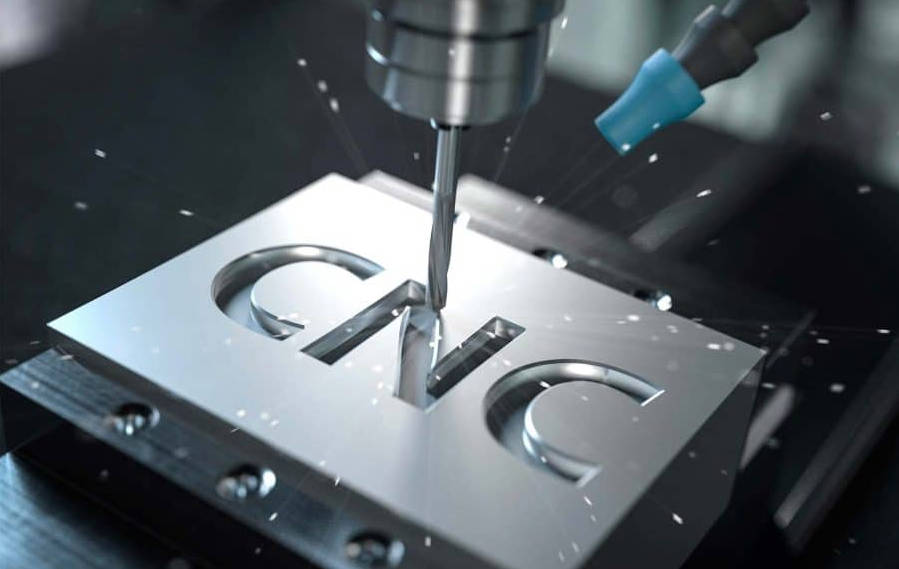
At its core, Computer Numerical Control (CNC) machining is a subtractive manufacturing technology. Unlike additive processes like 3D printing which build objects layer by layer, CNC machining starts with a solid block of material (known as a blank or workpiece) and systematically removes material using high-speed rotating cutting tools or cutters. The entire operation is directed by a computer program, typically generated from a 3D Computer-Aided Design (CAD) file. This automation allows for the creation of complex geometries with incredibly high precision, making it a cornerstone of modern manufacturing for both prototyping and full-scale production.
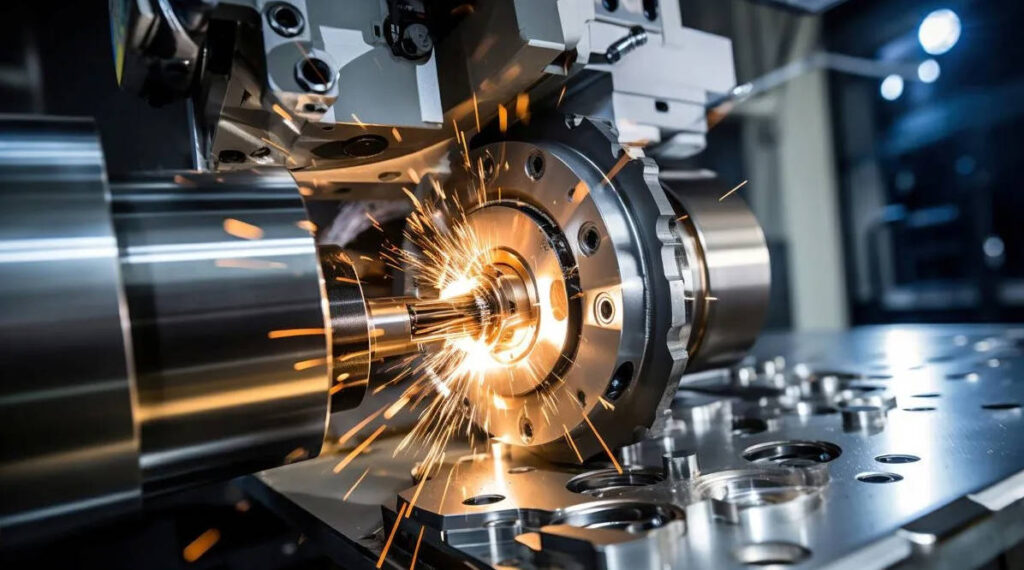
So, why would a buyer choose custom CNC machining over other methods like casting, forging, or 3D printing? The advantages are distinct and compelling. CNC machining offers unparalleled material versatility, capable of working with a vast range of production-grade metals and plastics that other processes cannot. It delivers superior dimensional accuracy and tight tolerances, critical for parts that must fit and function perfectly within an assembly. Furthermore, the surface finishes achievable through machining are often excellent right off the machine, with options for further polishing or treatment. While initial setup can be more involved than 3D printing, for low-to-medium volume production, CNC often proves more cost-effective and produces parts with superior mechanical properties.
Before You Request a Quote: Preparing Your Design for Manufacturing
The quality and cost of your final machined parts are largely determined before a single chip of metal is cut. A well-thought-out design and clear documentation are the most significant factors in achieving a successful outcome. Investing time in this preparatory phase will save you money, reduce lead times, and prevent costly miscommunications with your manufacturing partner.
The Cornerstone: Your CAD Model and Technical Drawings
The 3D CAD model is the universal language of CNC machining. Formats like STEP (.stp, .step) and IGES (.igs, .iges) are preferred because they are universally compatible with virtually all CAM (Computer-Aided Manufacturing) software. This 3D file contains the complete geometry of your part and is used to generate the toolpaths the CNC machine will follow. It is the single source of truth for the part’s shape and features.
However, a 3D model alone is often insufficient. It must be accompanied by a 2D technical drawing (typically in PDF format). Why? The drawing conveys critical information that the 3D model cannot, such as:
- Tolerances: Specifies the acceptable range of variation for specific dimensions.
- Geometric Dimensioning and Tolerancing (GD&T): A symbolic language used to define the nominal geometry and its allowable variation.
- Surface Finish Requirements: Indicates the required smoothness for specific surfaces (e.g., Ra 1.6 μm).
- Material Specifications: The exact grade of metal or plastic (e.g., Aluminum 6061-T6).
- Critical Features: Highlighting holes, threads, or surfaces that have special functional importance.
- Post-processing Notes: Instructions for anodizing, powder coating, heat treatment, or other finishing steps.
Critical DFM (Design for Manufacturability) Principles to Reduce Costs
Design for Manufacturability (DFM) is the practice of designing parts in a way that makes them easier and more affordable to manufacture. Integrating DFM principles is the single most effective way a buyer can reduce the cost of their custom CNC parts without sacrificing function. An experienced machine shop will often provide DFM feedback, but designing with these rules in mind from the start is even better.
Key DFM considerations include:
- Simplify Geometry: Complex, free-form curves are more time-consuming to machine than straight lines and simple arcs. Every complex surface requires more programming and machine time, directly increasing cost.
- Use Generous Radii on Internal Corners: CNC tools are round, so they cannot create perfectly sharp internal corners. A corner radius that is slightly larger than the tool’s radius allows for faster, continuous cutting. A good rule of thumb is to design inside corner radii to be at least 1/3 of the pocket’s depth.
- Avoid Deep, Narrow Pockets: Pockets with a high depth-to-width ratio require long, fragile tools that are prone to breaking and must be run at slower speeds. This drastically increases machining time. Try to keep pocket depths to less than 4x the tool diameter.
- Standardize Hole Sizes and Threads: Using standard drill bit sizes and common thread types (e.g., M6 instead of M5.5) eliminates the need for special tooling, saving both time and money.
- Relax Tolerances Where Possible: Only apply tight tolerances to a part’s critical features. Unnecessarily tight tolerances across an entire part can increase its cost by 2-5x due to slower machining speeds, special handling, and more rigorous inspection requirements.
Navigating Key Technical Specifications
Once your design is optimized, you must define the technical specifications. These choices directly impact your part’s performance, appearance, and cost. Making informed decisions on the process, material, and finish is a crucial step for any buyer.
Which CNC Machining Process is Right for Your Part?
While “CNC Machining” is a broad term, it primarily consists of two main processes: milling and turning. Many modern shops also utilize multi-axis machines that combine these capabilities.
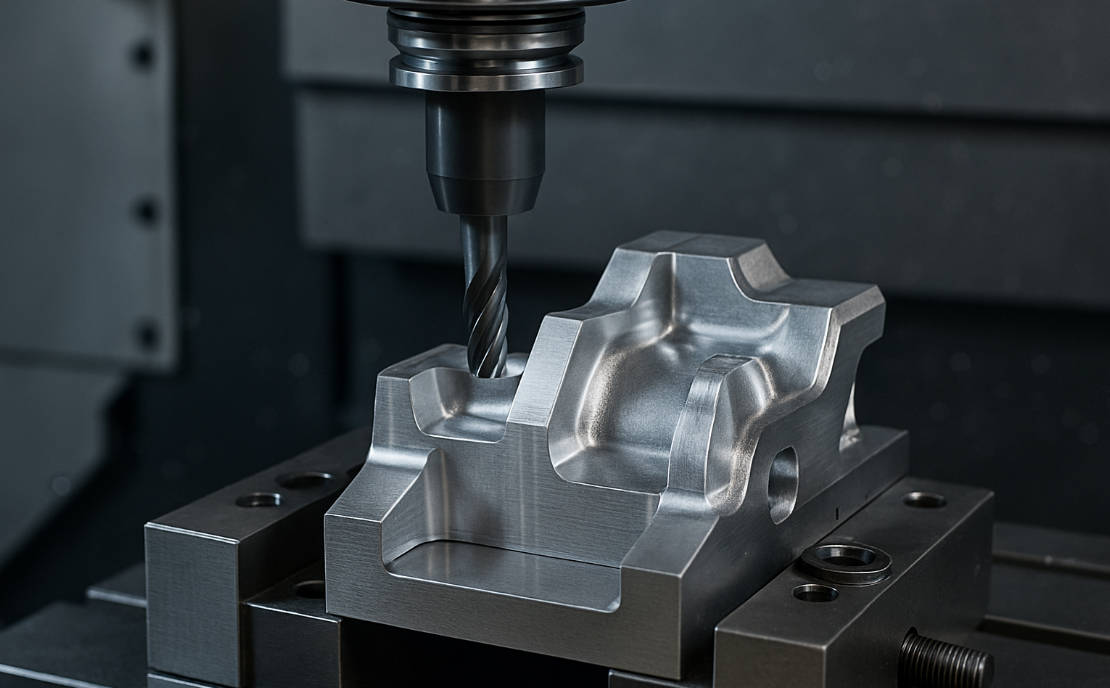
- CNC Milling: In milling, the workpiece is held stationary while a rotating cutting tool moves along multiple axes to remove material. This process is ideal for creating parts with flat surfaces, pockets, holes, and complex 3D contours. It’s used for everything from engine blocks to custom enclosures.
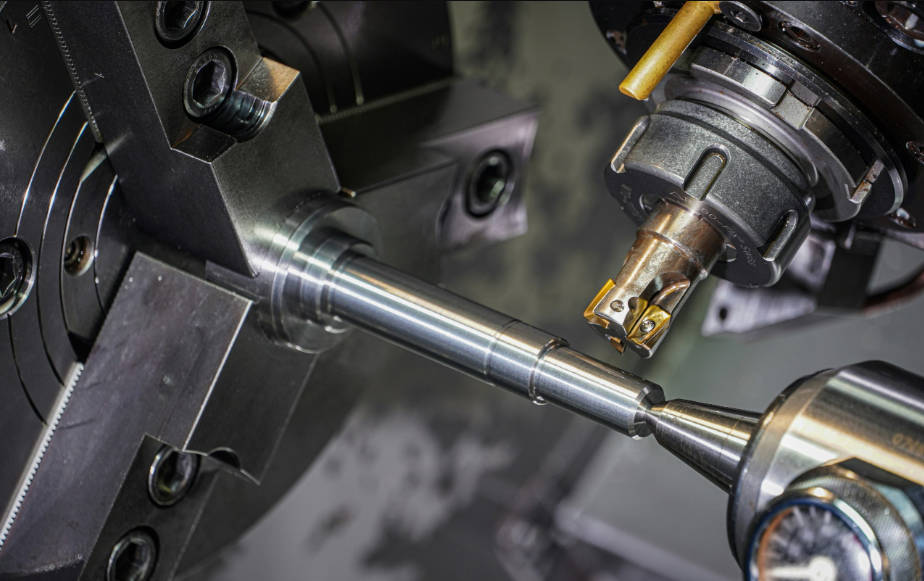
- CNC Turning (Lathe): In turning, the workpiece rotates at high speed while a stationary cutting tool removes material. This is perfect for creating cylindrical, conical, or spherical parts with rotational symmetry, such as shafts, pins, nozzles, and flanges.
- 5-Axis CNC Machining: This advanced process allows the cutting tool and/or the workpiece to move along five different axes simultaneously. It enables the creation of extremely complex geometries in a single setup, which improves accuracy and reduces machining time for parts that would otherwise require multiple setups. It is more expensive but essential for intricate components found in aerospace and medical applications.
How to Select the Right Material for Your Application
CNC machining is compatible with a massive library of metals and plastics. The choice depends on factors like required strength, weight, corrosion resistance, temperature resistance, and of course, budget. Below is a table of common materials and their characteristics.
| Material | Key Characteristics | Common Applications | Relative Cost |
|---|---|---|---|
| Aluminum 6061 | Excellent strength-to-weight ratio, good corrosion resistance, highly machinable, can be anodized. | Prototypes, electronic housings, structural components, consumer products. | Low |
| Stainless Steel 304 | Excellent corrosion resistance, high strength, good for sanitary applications. | Medical devices, food processing equipment, kitchen hardware. | Medium |
| Carbon Steel 1018 | Good machinability, weldable, strong and tough. Prone to rust if not coated. | Jigs, fixtures, machine components, shafts. | Low |
| Delrin (POM) | High stiffness, low friction, excellent dimensional stability, good chemical resistance. | Gears, bearings, bushings, high-performance components. | Medium |
| PEEK | Very high-performance thermoplastic, excellent mechanical and thermal properties, biocompatible. | Aerospace components, medical implants, semiconductor parts. | Very High |
Understanding Tolerances and Surface Finish
Tolerance refers to the permissible limit of variation in a physical dimension. A standard machining tolerance might be ±0.1mm (±0.005″), which is suitable for many applications. However, if a part needs to press-fit with another, a much tighter tolerance (e.g., ±0.01mm) might be necessary. It is crucial to remember that every tightened tolerance increases cost. The machinist must use more precise tools, run the machine slower, and perform more detailed inspections. As a buyer, you should only specify tight tolerances on functionally critical dimensions and leave non-critical features at a standard, more economical tolerance.
Surface finish, often denoted as Ra (Roughness Average), measures the smoothness of a part’s surface. A standard machined finish (around Ra 3.2 μm) has faint but visible tool marks. This is cost-effective and acceptable for most parts. If a part requires a smoother finish for sealing, aesthetics, or reduced friction, a lower Ra value (e.g., Ra 0.8 μm) can be specified. Achieving very fine finishes requires additional machining passes or secondary operations like grinding or polishing, which adds to the overall cost.
Decoding the Cost of Custom CNC Machining
Understanding what drives the price of a machined part empowers buyers to make smart, cost-saving decisions. The quote you receive from a machine shop isn’t arbitrary; it’s a calculation based on several key factors. By understanding these levers, you can work with your supplier to optimize your project’s budget.
The primary cost drivers are:
- Material Cost: This is the baseline cost of the raw stock. High-performance materials like Titanium or PEEK are significantly more expensive than common aluminum or steel. Waste material also contributes to this cost, so designs that can be nested efficiently on a stock sheet are more economical.
- Machining Time: This is often the largest component of the cost. It is a direct function of your part’s complexity, size, and feature count. A simple plate with a few holes will machine quickly, while a complex housing with 3D contours and many small features will take hours, driving the price up accordingly.
- Setup Costs: This is the one-time cost associated with preparing for a job. It includes CAM programming, fixture design, tool selection, and machine calibration. This cost is fixed whether you order 1 part or 100 parts, which is why the per-part price drops significantly with higher quantities as the setup cost is amortized across more units.
- Post-Processing & Finishing: Any step after machining adds cost. This includes deburring, cleaning, anodizing, powder coating, heat treating, or specialized inspections (like CMM reports). Be sure to only specify the finishing steps that are absolutely necessary for your application.
How to Choose the Right CNC Machining Partner
The final piece of the puzzle is selecting the right manufacturing partner. The cheapest quote is not always the best value. A good partner acts as an extension of your team, providing expertise and ensuring a smooth process from start to finish.
Evaluating a Machine Shop’s Capabilities and Expertise
Before committing, assess the shop’s technical fit for your project. Look for evidence of their capabilities and quality. Do they have the right machines for your part’s complexity, such as 5-axis mills if needed? Do they have experience working with your specified material? Most importantly, check for quality certifications. An ISO 9001 certification is a strong indicator of a mature and reliable quality management system. If you are in a specialized field, look for relevant certifications like AS9100 for aerospace or ISO 13485 for medical devices.
Requesting a Quote: What to Provide for an Accurate Price
To get a fast and accurate quote, provide your potential partner with a complete “quote package.” The more clear and complete your information, the less guesswork the shop has to do, resulting in a more precise price and fewer delays. Your package should always include:
- 3D CAD Files: (STEP, IGS)
- 2D Technical Drawings: (PDF) with tolerances, finishes, and all critical notes.
- Material Specification: Exact grade required.
- Quantity: Specify the number of units. It’s often helpful to request pricing for multiple quantity breaks (e.g., 10, 50, 200 pcs) to see the price scaling.
- Desired Finish/Post-Processing: Anodizing, painting, etc.
- Target Lead Time: When do you need the parts?
Beyond Price: Assessing Communication and Support
A great CNC machining partner is a great communicator. When you first reach out, how responsive are they? Do they ask clarifying questions about your design? The best shops will proactively offer DFM feedback, suggesting minor design changes that could save you significant money or improve the part’s functionality. This collaborative approach is a hallmark of a trustworthy partner who is invested in your success, not just in winning a bid. Pay attention to their willingness to engage and help; it’s often a better indicator of a successful long-term relationship than a rock-bottom price.
Your CNC Machining Checklist for a Successful Project
- Finalize Your Design: Create a complete 3D CAD model (STEP/IGS).
- Apply DFM Principles: Simplify geometry, add radii, and use standard features to reduce cost.
- Create a Technical Drawing: Detail all tolerances, surface finishes, materials, and critical notes.
- Select the Right Material: Balance performance requirements with budget.
- Identify Potential Partners: Look for shops with relevant experience and quality certifications (ISO 9001).
- Compile a Quote Package: Gather all files and specifications.
- Request Quotes from 2-3 Shops: Compare not just price, but DFM feedback and communication quality.
- Review and Select Your Partner: Choose the shop that offers the best overall value, not just the lowest price.
Conclusion: Partnering for Precision and Success
Navigating the world of custom CNC machining can seem daunting, but by arming yourself with knowledge, you can transform it into a predictable and highly effective manufacturing process. Success is not just about a good design; it’s about understanding the interplay between design, materials, cost, and a collaborative partnership with your chosen machine shop. By focusing on clear communication, embracing DFM, and specifying requirements intelligently, buyers can ensure they receive high-quality, precise parts on time and on budget. A successful CNC project is a testament to a strong partnership built on expertise, trust, and a shared goal of manufacturing excellence.
custom cnc machining, what buyers should know, cnc machining guide, how to order cnc parts, cnc machining cost, design for manufacturability cnc, choosing cnc machine shop, cnc material selection, precision machining, cnc fabrication, what is cnc machining, cnc milling, cnc turning