In the world of precision manufacturing, selecting the right material is more than a technical decision—it is a financial strategy. For project managers, engineers, and procurement specialists seeking CNC machining services, the debate often narrows down to two industry titans: Aluminum and Stainless Steel.
While Aluminum is celebrated for its lightweight and rapid machinability, Stainless Steel is the gold standard for durability and corrosion resistance. However, the “cost” of a CNC machined part is not merely the price of the raw metal. It is a complex calculation involving cycle times, tool wear, labor, and post-processing.
Aluminum CNC machining is typically 20% to 50% more cost-effective than stainless steel machining due to significantly higher material removal rates, reduced tool wear, and shorter machine cycle times. This guide provides a deep dive into the cost drivers to help you optimize your next production run.
I. Understanding the Initial Investment: Raw Material Costs
The first line item on any quote is the material cost. While market prices fluctuate, the fundamental relationship between these two metals remains consistent.
1. Price per Pound vs. Price per Part
On a per-pound basis, Aluminum is often cheaper than Stainless Steel, but the gap isn’t always as wide as people think. The real difference lies in density.
- Aluminum (e.g., 6061): Has a density of approximately $2.70 \text{ g/cm}^3$.
- Stainless Steel (e.g., 304): Has a density of approximately $8.00 \text{ g/cm}^3$.
Because Stainless Steel is nearly three times as dense as Aluminum, you need three times the weight of steel to produce the same volume of parts. Therefore, even if the price per pound were identical, the Stainless Steel part would still cost three times more in raw material alone.
2. Common Grades and Availability
- Aluminum 6061-T6: The most “standard” grade. It is highly available and offers the best balance of cost and performance.
- Stainless Steel 304: The most common stainless grade, though it is “gummy” and harder to machine than Aluminum.
- Stainless Steel 303: Specifically designed for “free-machining.” If your project allows it, switching from 304 to 303 can reduce costs by improving machining speeds.
II. Machinability: The “Hidden” Driver of CNC Costs
In CNC machining, time is money. The most significant cost difference between these materials is not the metal itself, but how long it stays on the machine.
1. Surface Feet per Minute (SFM)
Machinability is measured by how fast a cutting tool can move through the material.
Aluminum has a machinability rating of nearly 300% to 400% compared to most stainless steel grades, allowing for much higher cutting speeds and feed rates that drastically reduce total machine cycle time.
2. Material Removal Rate (MRR)
Aluminum is a “soft” metal with high thermal conductivity. It allows the CNC machine to peel away large amounts of material quickly without overheating the tool. Stainless steel, conversely, is “tough” and prone to work-hardening. If the tool moves too slowly or generates too much heat, the steel becomes harder, making it even more difficult (and expensive) to cut.
| Feature | Aluminum (6061) | Stainless Steel (304) | Impact on Cost |
| Machinability Rating | ~360% (Excellent) | ~45% (Poor/Difficult) | Higher rating = Lower labor cost |
| Cutting Speed (SFM) | 600 – 1200+ | 100 – 250 | Faster speeds = Shorter cycles |
| Heat Generation | Low (Dissipates quickly) | High (Concentrates at tip) | High heat = More cooling/slower speeds |
| Chip Formation | Easy to break/clear | Long, stringy, and sharp | Difficult chips = More manual oversight |
III. Tooling and Equipment Wear
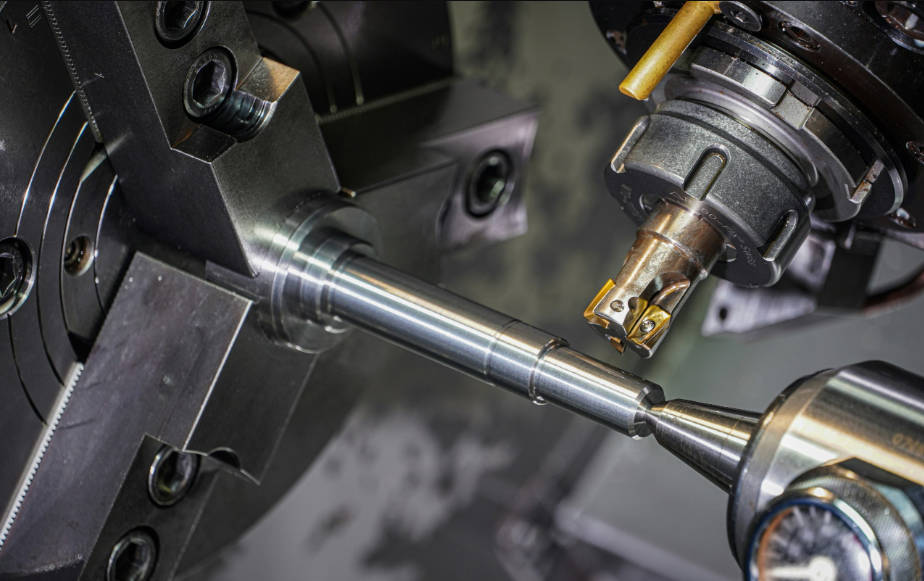
Stainless steel is an “abrasive” partner for CNC tools. This introduces secondary costs that are often overlooked during the initial design phase.
1. Tool Longevity
Because stainless steel is harder and generates more friction, cutting tools (end mills, drills, inserts) dull much faster. A tool that might last for 100 Aluminum parts may only last for 10 to 15 Stainless Steel parts.
2. Specialized Tooling
To machine Stainless Steel effectively, shops must use high-performance carbide tools with specialized coatings like AlTiN (Aluminum Titanium Nitride) to resist heat. These tools are significantly more expensive than the standard high-speed steel or basic carbide tools used for Aluminum.
3. Machine Maintenance
Machining “hard” metals puts more stress on the CNC machine’s spindle and motors. Over time, a shop that primarily machines Stainless Steel will have higher maintenance overhead, which is eventually passed down to the customer in the form of higher hourly shop rates.
IV. Post-Processing and Surface Finishing
The cost comparison doesn’t end when the part leaves the CNC machine. Surface requirements play a massive role in the final invoice.
1. Aluminum Finishing (Protection Needed)
Aluminum is highly reactive and will oxidize over time. Most professional applications require a finish:
- Anodizing (Type II or III): Adds a protective oxide layer. Type III (Hardcoat) is excellent for wear resistance but adds $20\%$ to $40\%$ to the part cost.
- Powder Coating: Great for aesthetics but requires extra handling.
2. Stainless Steel Finishing (Natural Resistance)
The primary cost-saving benefit of stainless steel is its inherent corrosion resistance, which often eliminates the need for expensive secondary coatings or platings, potentially offsetting its higher initial machining costs in harsh environments.
- Passivation: A chemical bath that removes “free iron” from the surface to prevent rust. It is relatively inexpensive.
- Electropolishing: Creates a mirror-like, ultra-clean finish often required for medical or food-grade parts.
V. Technical Trade-offs: When is the Extra Cost Justified?
Choosing the cheaper option (Aluminum) isn’t always the right move. As a professional CNC machining service provider, we advise clients to consider the following:
1. Strength-to-Weight Ratio
If your part needs to be lightweight (Aerospace, Drones, Handheld devices), Aluminum is the winner. However, if space is limited and you need maximum strength in a small volume, Stainless Steel’s superior tensile strength may be required regardless of cost.
2. Operating Temperature
Aluminum begins to lose structural integrity at temperatures above $200^\circ\text{C}$ ($400^\circ\text{F}$). If your component operates near engines or high-heat industrial equipment, Stainless Steel is a functional necessity.
3. Environment (Corrosion)
For marine applications or medical devices that undergo frequent sterilization with harsh chemicals, Aluminum (even anodized) may fail. In these cases, Stainless Steel 316 is the industry standard.
VI. Pro-Tips for Cost Reduction (DFM Optimization)
Regardless of the material you choose, you can lower your CNC machining cost by following Design for Manufacturing (DFM) principles.
- Increase Internal Radius: Use a larger radius for internal corners. This allows for larger, stronger tools that can cut faster.
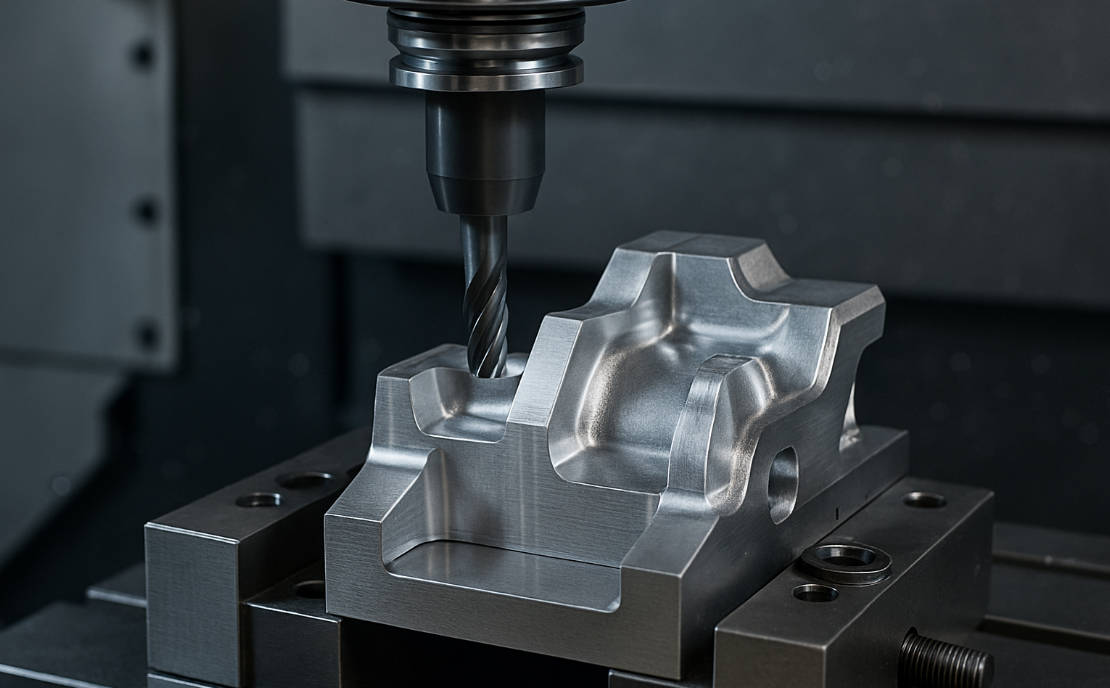
- Avoid Deep Pockets: Limit the depth of holes and pockets to 4x the tool diameter. Deep pockets in Stainless Steel are incredibly expensive due to tool deflection and breakage risks.
- Relax Tolerances: Do not specify $\pm 0.001$ mm unless absolutely necessary. Tighter tolerances in stainless steel can increase the price of a part by up to 50% because of the increased risk of scrap and the need for slower, more precise machining passes.
- Simplify Threading: Use through-holes for threads where possible. Tapping deep, blind holes in Stainless Steel is a high-risk operation that leads to broken taps and ruined parts.
VII. Conclusion: Making the Final Decision
There is no “one size fits all” answer. The choice between Aluminum and Stainless Steel depends on your budget, your part’s environment, and its mechanical requirements.
- Choose Aluminum 6061 if you need parts quickly, want to minimize costs, or require a lightweight component with a colorful anodized finish.
- Choose Stainless Steel 304/316 if your part faces extreme heat, requires high strength, or must survive in a corrosive or sterile environment.
By understanding the interplay between material price, cycle time, and tooling wear, you can make a procurement decision that balances performance with the bottom line.