In the rapidly evolving landscape of manufacturing, misconceptions can be costly. For product designers, engineers, and procurement managers, choosing the right manufacturing process is often the difference between a profitable product launch and a budget overrun.
While CNC machining services (Computer Numerical Control) have been the backbone of precision manufacturing for decades, a surprising amount of misinformation still surrounds the technology. With the flashy rise of industrial 3D printing (Additive Manufacturing), many professionals have started to view CNC machining as “too expensive,” “too slow,” or “outdated.”
These myths are not just harmless errors; they are strategic blind spots. Believing them leads businesses to choose inferior materials, compromise on tolerances, or overspend on prototyping methods that don’t scale.
In this comprehensive guide, we are peeling back the layers of the industry to debunk the 5 most common myths about CNC machining. We will provide the technical data, cost comparisons, and design insights you need to make an informed decision for your next project.
Myth #1: “CNC Machining is Always More Expensive Than 3D Printing”
This is perhaps the most pervasive myth in modern product development. Because 3D printing (additive manufacturing) requires no tooling and has virtually no setup cost, many assume it is universally cheaper.
The Reality:
While 3D printing is cheaper for a single complex unit, CNC machining becomes significantly more cost-effective as soon as volumes increase beyond the prototyping phase. Furthermore, the “sticker price” of 3D printing often hides post-processing costs that are included in CNC pricing.
The Economics of Scale: Additive vs. Subtractive
To understand the cost difference, we must look at how costs are calculated.
- 3D Printing Cost: Primarily driven by time and material volume. Printing 10 parts takes roughly 10 times as long as printing 1 part. The unit cost remains relatively flat.
- CNC Machining Cost: Driven by setup (programming, fixturing) and run time. Once the machine is set up, the actual cutting time is fast.
CNC machining offers a steep drop in per-unit cost as quantities rise. The high initial setup cost is amortized across the entire batch.
Cost Comparison Scenario (Example: Aluminum Enclosure)
| Quantity | 3D Printing (DMLS – Metal) | CNC Machining (Aluminum 6061) | Winner |
| 1 Unit | $350 | $450 | 3D Printing |
| 5 Units | $350 each | $180 each | CNC Machining |
| 50 Units | $340 each | $45 each | CNC Machining |
| 500 Units | $330 each | $22 each | CNC Machining |
The Hidden Cost of Post-Processing
When you order a CNC machining service, the part comes off the machine with excellent structural integrity and a smooth surface finish (typically Ra 1.6 to 3.2 µm).
In contrast, 3D printed parts often require:
- Support Removal: Manual labor to snap off support structures.
- Surface Finishing: Extensive sanding or bead blasting to remove layer lines.
- Thread Tapping: Printed holes are rarely precise enough for screws, requiring secondary drilling and tapping.
Google Snippet Takeaway: Contrary to popular belief, CNC machining is often more cost-effective than 3D printing for quantities greater than 10 units. The per-unit cost of CNC machining drops drastically with volume due to speed and efficiency, whereas 3D printing costs remain flat.
Myth #2: “CNC Machining is Only for High-Volume Production”
On the flip side of the first myth, some procurement managers believe that unless they are ordering 10,000 units, they shouldn’t bother a machine shop. They assume CNC is reserved for mass production similar to injection molding.
The Reality:
CNC machining is the king of “Low-Volume, High-Mix” production. It is the perfect bridge between a prototype and a mass-market product.
The Rise of “Rapid CNC”
Historically, setting up a CNC mill took hours or days. Today, modern CAM (Computer-Aided Manufacturing) software and modular fixturing have slashed setup times. This has given rise to Rapid CNC Prototyping.
Leading machine shops can now profitably run a “batch of one.” This allows engineers to test the exact material (e.g., Stainless Steel 316 or Delrin) that will be used in the final product, rather than a 3D printed simulant.
Bridge Manufacturing (Soft Tooling)
Before investing $50,000 in a steel mold for injection molding, companies often need a “bridge” run of 500 to 1,000 units for market testing or early adopters.
- Injection Molding: Requires 8-12 weeks for mold creation.
- CNC Machining: Can deliver 500 parts in 2 weeks.
Why CNC is ideal for Low-Volume Production:
- No Minimum Order Quantity (MOQ): You can order exactly what you need.
- Design Agility: If you find a flaw in unit #50, you can update the CAD file and unit #51 will be correct. With injection molding, changing the design requires scrapping an expensive mold.
Google Snippet Takeaway: CNC machining is an ideal solution for low-volume production (1 to 1,000 parts) and rapid prototyping. It allows engineers to test functional parts in real materials without the high upfront tooling costs associated with injection molding.
Myth #3: “CNC Machines Can Make Anything You Draw in CAD”
Designers who grow up using 3D printers often fall into the trap of thinking, “If I can model it in SolidWorks, the machine can make it.”
The Reality:
CNC machining is a subtractive process bounded by physics. The cutting tool must be able to reach the material, and the part must be held securely. Ignoring Design for Manufacturing (DFM) principles is the fastest way to receive a “No Quote” or an exorbitant price tag.
The “Square Corner” Fallacy
This is the most common error in CNC design.
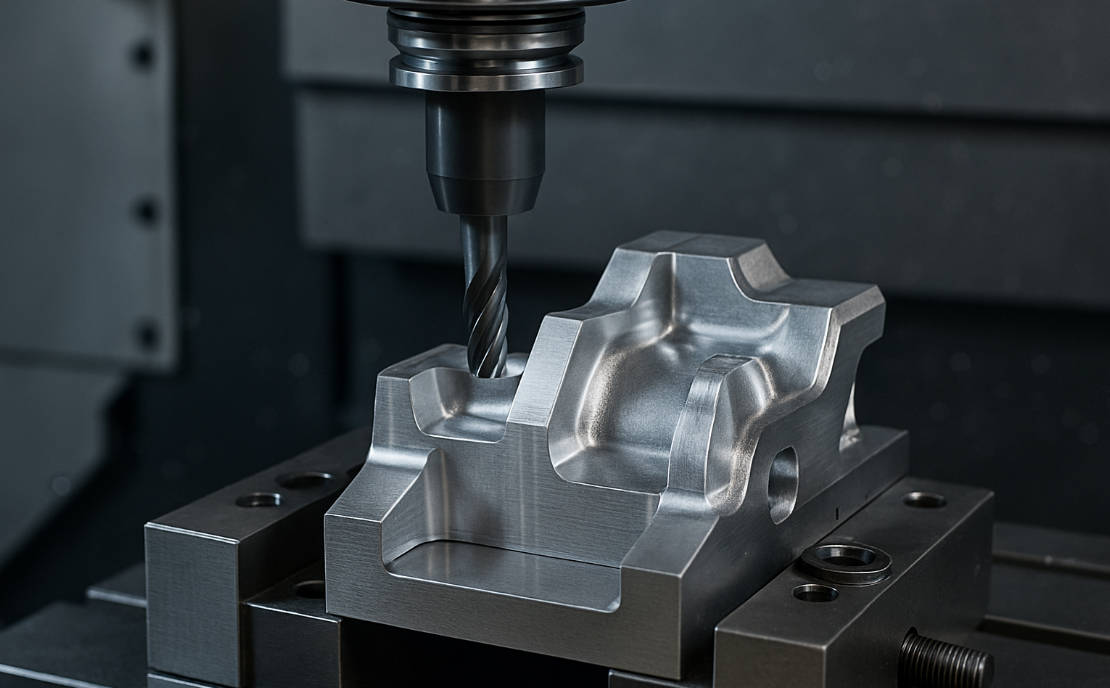
- The Issue: CNC end mills are round and rotate. They cannot cut a perfect internal 90-degree corner.
- The Consequence: If your drawing specifies a sharp internal corner, the machinist must use EDM (Electrical Discharge Machining), a slow and expensive process that uses a shaped electrode to burn away material.
- The Fix: Always add a radius (fillet) to internal corners. Ideally, the radius should be slightly larger than the tool radius to allow for smooth cutting.
The Undercut Limitation
Standard 3-axis CNC machines cut from the top down. They cannot reach underneath a ledge or overhang (an undercut).
- The Workaround: Undercuts require re-orienting the part (adding setups) or using specialized T-slot cutters.
- The Better Solution: Redesign the part to avoid undercuts or use a 5-axis CNC machining service which can rotate the part to reach difficult angles.
Design Feature Feasibility Table
| Feature | CNC Feasibility | Cost Impact | Recommendation |
| Internal Sharp Corners | Impossible (Requires EDM) | High | Add Fillets/Radii |
| Deep Narrow Holes | Difficult | Medium | Limit depth to 4x Diameter |
| Thin Walls (<0.5mm) | Risky (Vibration) | High | Increase thickness |
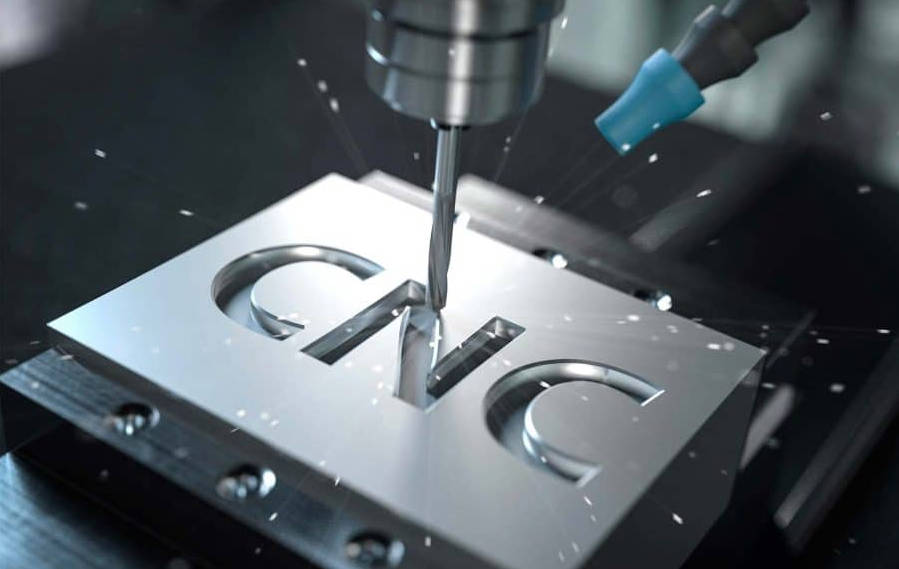
| Text/Logos | Easy | Low | Use Engraved, not Embossed |
| Curved Holes | Impossible | N/A | Design straight holes |
Google Snippet Takeaway: CNC machines have physical limitations, such as the inability to cut sharp internal corners or reach undercuts without special setups. Successful CNC design requires adhering to DFM principles like adding radii to corners and avoiding deep, thin cavities.
Myth #4: “CNC Machining is an Outdated Technology”
In an era of AI and laser sintering, a spinning metal cutter can seem “old school.” Some view CNC as a legacy technology that hasn’t changed since the 1980s.
The Reality:
CNC machining is currently undergoing a massive technological renaissance. It remains the standard for high-precision industries like Aerospace, Medical, and Automotive because it delivers tolerances and material properties that new technologies cannot match.
The Power of 5-Axis Machining
Traditional machining moves in 3 axes (X, Y, Z). Modern 5-axis CNC machining adds two rotational axes (A and B).
This allows the cutting tool to approach the part from virtually any direction.
- Complex Geometries: Impellers, turbines, and organic shapes are now standard CNC work.
- Single Setup Precision: By machining 5 sides of a part without removing it from the vise, 5-axis machines maintain superior positional accuracy.
Automation and “Lights-Out” Manufacturing
Modern machine shops are increasingly automated.
- Robotic Loading: Robots load raw material and unload finished parts, allowing machines to run 24/7 without human intervention.
- In-Process Probing: Machines are equipped with Renishaw probes that measure the part while it is being cut, automatically adjusting for tool wear to ensure micron-level accuracy.
Material Superiority
While 3D printing materials are improving, they are often simulants or powders held together with binders.
CNC machining uses solid blocks (billets) of engineering-grade material. A CNC machined block of 7075 Aluminum or PEEK plastic has isotropic strength—it is equally strong in all directions. 3D printed parts are often weaker along the Z-axis (layer lines).
Google Snippet Takeaway: CNC machining is a cutting-edge technology utilizing 5-axis robotics, AI-driven tool paths, and automated inspection. It remains the only manufacturing method capable of delivering tight tolerances (+/- 0.01mm) in true engineering-grade materials.
Myth #5: “Lead Times for CNC Parts Take Weeks”
The traditional image of outsourcing CNC parts involves sending a fax or email, waiting 5 days for a quote, and then waiting 4 weeks for the parts.
The Reality:
The “Digital Manufacturing” revolution has drastically shortened lead times. For many projects, CNC machining is now faster than 3D printing.
The Instant Quote Revolution
Modern CNC machining services utilize AI-powered quoting engines. You upload a STEP file, and the algorithm analyzes the geometry, calculates run time, and generates a price in seconds.
This eliminates the back-and-forth communication lag.
Optimized Digital Workflow
Once an order is placed, the CAD file is often sent directly to the CAM programming department. With libraries of pre-set tool paths and standardized tooling, a part can go from “Order” to “Cutting” in a matter of hours.
- Standard Lead Time: 10-15 Days
- Expedited Lead Time: 3-5 Days
- Rush/Emergency: 24 Hours (Available at premium shops)
Compared to industrial 3D printing, which can take 24-48 hours just to cool down and another 24 hours for cleaning, a simple CNC part can be machined in 10 minutes.
Google Snippet Takeaway: Modern CNC machining services offer rapid lead times, often as fast as 3 days for prototype parts. Thanks to instant quoting engines and automated workflows, CNC is now a viable option for tight deadlines.
Conclusion: Choosing the Right Tool for the Job
Debunking these myths reveals a clear truth: CNC Machining is not a relic of the past; it is a versatile, high-speed, and cost-effective solution for modern manufacturing.
To summarize:
- Cost: CNC is cheaper than 3D printing for production runs and complex functional parts.
- Volume: It is ideal for everything from single prototypes to mid-volume bridge production.
- Design: While it has limitations (like sharp corners), DFM makes it incredibly powerful.
- Technology: 5-axis machines and automation are pushing the boundaries of what is possible.
- Speed: With digital quoting, you can get parts in days, not weeks.
The key to successful project management isn’t finding the “newest” technology, but choosing the process that delivers the best balance of cost, speed, and quality. For parts that require structural integrity, precise tolerances, and scalability, CNC machining remains the undisputed champion.
Ready to Start Your Project?
Don’t let misconceptions slow down your product development. At [Your Company Name], we combine state-of-the-art 5-axis CNC technology with expert engineering support to bring your designs to life.
Upload your CAD files today for a free design review and instant quote. Experience the speed and precision of modern CNC machining services.